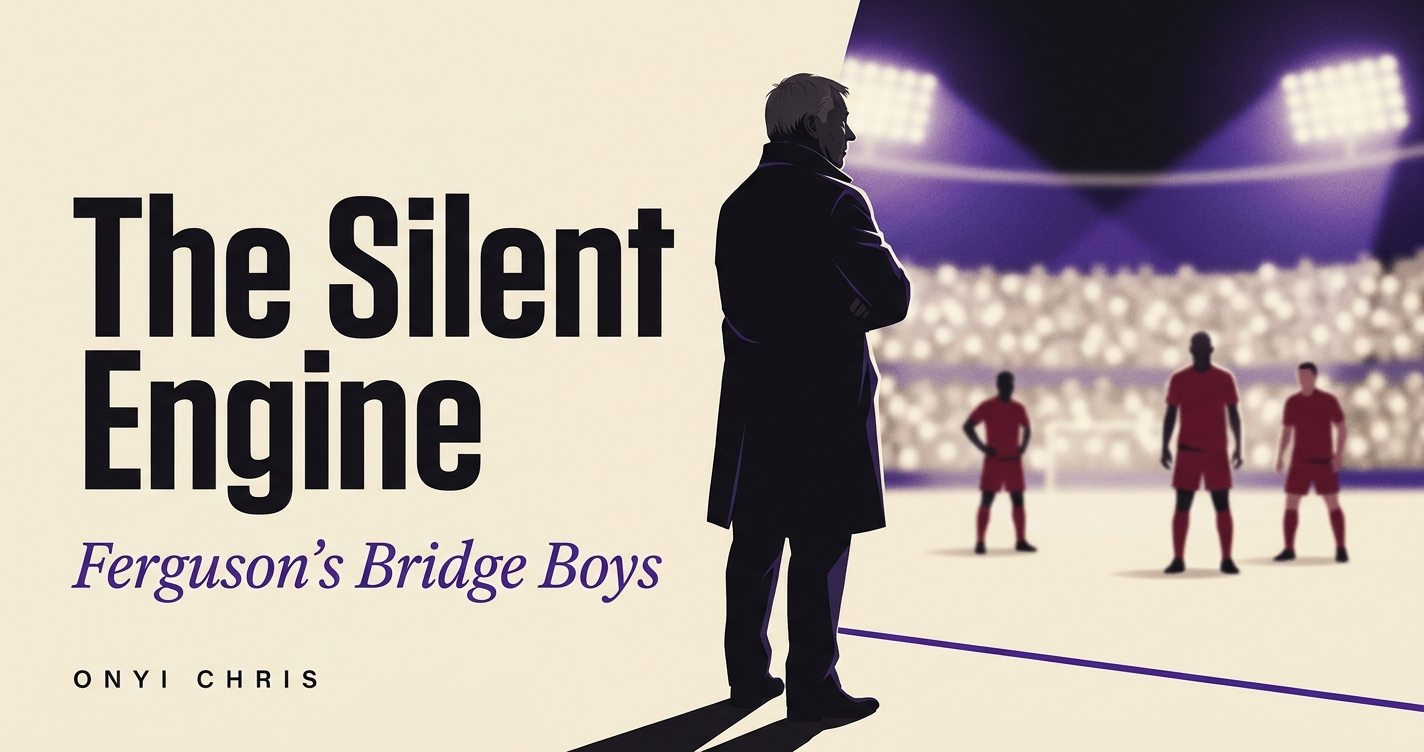
Ferguson's Bridge Boys, and the people who keep every system running.
26 May 1999, Camp Nou. Injury time. Sheringham equalises, Solskjær wins it, and Manchester United complete the Treble. Everyone remembers that night: Beckham's corners, Schmeichel up for the corner, the Class of '92 at the peak of their powers.
Hardly anyone remembers that a 19-year-old defender from the academy was sitting on the bench. Wes Brown didn't get on. He collected a winner's medal for a final he only watched.
That's the story I want to tell. Not the one about the stars. The one about the people who kept the machine running after the stars moved on.
The gap nobody talks about
The Class of '92 (Giggs, Beckham, Scholes, Butt and the Nevilles) became superstars together. A generation like that doesn't come twice, and Ferguson knew it.
Within a few years the Treble side was breaking up. Stam left in 2001. Beckham went to Madrid in 2003. Butt left in 2004 and Keane in 2005. Ferguson needed a new core, and he couldn't buy all of it. He spent big where it mattered most, on Ronaldo in 2003 and Rooney in 2004. The rest had to come from somewhere cheaper, closer and more loyal.
It came from the academy.
Ferguson's Bridge Boys
Wes Brown was the first. A Mancunian who could play centre-back or right-back, he spent years fighting serious injuries and kept coming back. He played more than 350 games for United and won a string of league titles and two Champions Leagues.
John O'Shea was the man Ferguson could put anywhere. Over nearly 400 games he played almost every position on the pitch. In February 2007 at Tottenham, with Van der Sar off with a broken nose and the substitutes used up, he went in goal and kept a clean sheet. A month later he came off the bench at Anfield and scored the winner in stoppage time, in the season United took the title back.
Darren Fletcher took longer to win the fans over. He ended up as the midfielder Ferguson trusted on the biggest nights, with 342 appearances in a career he fought to save from a serious illness. When a harsh red card ruled him out of the 2009 final against Barcelona, Ferguson named his absence as one of the reasons United lost. You only notice the engine when it's missing.
None of them were poster boys. No Ballon d'Or talk, no global shirt sales. What they gave Ferguson was different: they accepted squad roles, covered whatever position was needed, understood the club without being told, and let him spend big only where it counted.
The ones who didn't make it
For every Brown, O'Shea and Fletcher, the academy produced players who almost made it. Luke Chadwick played a few dozen first-team games. Kieran Richardson won a League Cup before building his career at Sunderland. Danny Simpson left and won the league with Leicester in 2016. Phil Mulryne left football and became a Catholic priest. Jimmy Davis, whom many expected to make it, died in a car crash in 2003 at just 21.
That's what a good system looks like. It doesn't only produce stars. It produces enough dependable people that the whole thing keeps working.
Moscow, 2008
21 May 2008, the Champions League final against Chelsea. In the 26th minute, Ronaldo rises at the back post and heads United in front. It's the image everyone kept.
The cross came from Wes Brown. The boy on the bench in 1999 delivered the ball. The star finished it.
Brown later said that cross wasn't luck. They had planned it, because Chelsea had a midfielder playing right-back and Ronaldo was so good in the air. Quiet preparation, done by the person nobody was watching.
Every team has a silent engine
I think about this a lot in my own work. In every company I've worked with there's a Fletcher or an O'Shea: the person who knows why the report adds up, who covers when someone is out, who fixed the integration nobody else understood, who quietly writes down how things work so the team doesn't fall apart when they're on leave.
The app is the front face. The system underneath does the real work. Football is no different. Ronaldo and Rooney were the front face of Ferguson's last great side. Brown, O'Shea and Fletcher were the system underneath.
Ferguson's genius wasn't only buying Ronaldo. It was knowing who to keep, and trusting them on the biggest nights. If you lead a team, find your silent engine and tell them you see them. If you are the silent engine, know this: your work is a big part of why the stars look good.
Nobody bought their shirts. Ferguson didn't need them to.
Building systems like this is what my course, Becoming a Systems Person, is about. Modules 0 and 1 are free.